Germany has a pretty buoyant market for those with the right language skills to be recognised as an expert. However, the reality may create difficulties for some German learners who are trying to reach the level of an expert compared to other languages. In Germany you will find a large number of people at Level A1, therefore it is important to understand what benefits you will receive when moving from Level A1 to Level A2, before starting to learn the language.
As Level A1 has a great introduction to the language and gives a good grounding, it does provide some basic knowledge which can help you on your journey from Level A2 to Level B1. Therefore, Level A2 is definitely more difficult than Level A1, however that's not to say it won't carry with it a high level of personal satisfaction for many of those who are looking to improve their German skills.
Understanding the CEFR German Levels
There are six levels of proficiency for German. The levels are based on the Common European Framework of Reference for Languages (CEFR), which is the standard used by educational institutions to measure language skills.
The six levels are:
- German A1 Level: For Beginners
- German A2 Level: Elementary
- German B1 Level: Intermediate
- German B2 Level: Upper Intermediate
- German C1 Level: Advance Level German
- German A2 Level: Elementary
As you progress through the levels, you will develop your ability to communicate in increasingly complex ways in real life.
What Is German A1 Level: For Beginners?
The A1 level of proficiency in German is a beginner's level. At the A1 level, you will learn to communicate in simple ways for everyday life.
You'll learn how to:
- Introduce yourself
- Ask and answer simple questions
- Talk about family and friends
- Order food
- Ask for directions
- Count numbers
- Tell the time
- Read basic signs and notices
Grammar Topics
- At A1, you'll study:
- Present tense verbs
- Articles (der, die, das)
- Personal pronouns
- Basic sentence structure
- Question words
- Modal verbs
- Simple prepositions
- Possessive pronouns
Vocabulary
Around 500–800 words.
What is German A2 Level: Elementary?
For most students, the A2 Level will substantially expand what they learned at the A1 level.
In addition, you will gain greater confidence when having general conversations and will be able to express your thoughts, experiences and future intentions.
You'll learn how to:
- Describe past events
- Talk about hobbies
- Discuss travel
- Explain routines
- Express preferences
- Write longer emails
- Understand short newspaper articles
- Participate in simple conversations
Grammar Topics
A2 introduces more complex grammar, including:
- Perfect tense (Perfekt)
- Reflexive verbs
- Comparative and superlative adjectives
- Subordinate clauses
- Dative and accusative cases
- Separable verbs
- More prepositions
- Word order changes
Which Level Is Harder?
The answer is clear:
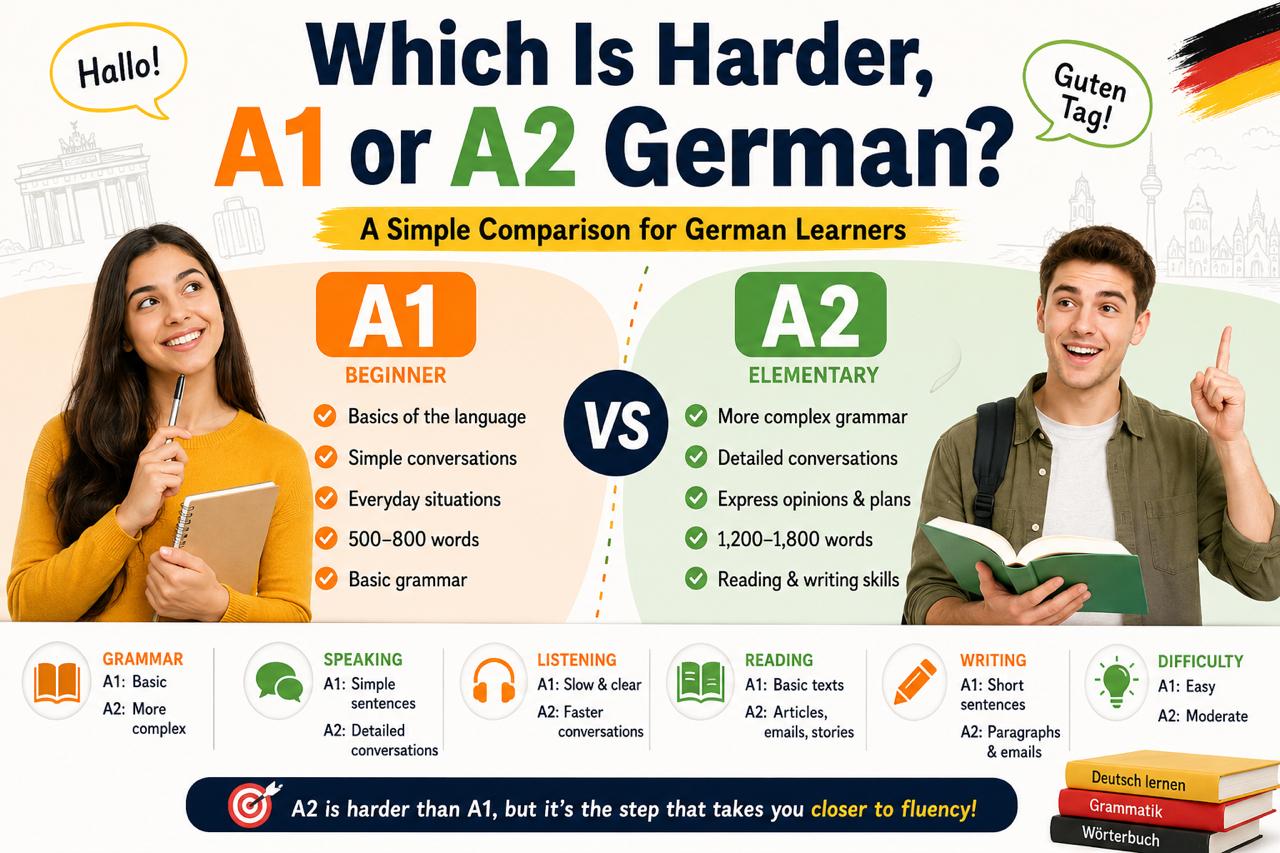
German A2 Level : Elementary is harder than German A1 Level : For Beginners.
Here's why.
1. More Grammar Rules
A1 is about simple sentences.
Example:
Ich wohne in Berlin
A2 is about:
- Simple Past
- Complex Sentences
- Two-object sentences
- Four Cases
- Long verb forms
These things are going to require a lot of practice.
2. Increased Vocabulary
A1 uses German for survival.
A2 allows you to use German for more topics such as:
- Health
- Shopping
- Transportation
- Weather
- Work
- School
- Entertainment
- Daily Life
Thus, you will need to remember nearly twice as many words.
3. Listening Speed Increases
During A1 recordings will be slow and clear.
During A2 recordings will be at a faster pace with:
- Native speakers
- Faster conversation
- Connected speech
- Different dialects
This may feel very overwhelming to begin with.
4. Reading Increases in Detail
A1 reading materials include:
- Menus
- Signs
- Advertisements
A2 reading materials include:
- Short articles
- Notices
- Stories
- Timetables
Reading materials will become longer, and will have more words you do not know.
5. To Speak With Confidence
At Level A1 ,Your answers to simple questions
Examples:
- What is your name?
- Where are you located?
At Level A2, Answering more involved questions.
Examples of level A2 questions:
- What would you like to know about your hometown?
- What was your last vacation like?
- What is your average day like?
- What are your daily interests?
- Speaking Necessitates Fluency.
6. Higher Level Writing Ability
Writing at Level A1 consists mostly of:
- Completing forms
- Writing short sentences
- Writing introductory sentence
Writing at level A2 requires:
- Writing Emails
- Invitations
- Learning from past experiences
- Descriptions of things
- Expressing opinions
Sentences you write will also get much more complex.
Comparison Between A1 or A2 German?
Feature German A1 Level: For Beginners German A2 Level : Elementary
| Difficulty | Easy | Moderate |
|---|---|---|
| Vocabulary | 500–800 words | 1,200–1,800 words |
| Grammar | Basic | More complex |
| Speaking | Simple conversations | Detailed conversations |
| Listening | Slow speech | Faster speech |
| Reading | Basic texts | Short articles & emails |
| Writing | Short sentences | Paragraphs & emails |
Is A2 Hard for Newbies?
Not at all.
A2 may seem challenging because it is based on everything learnt in A1.
If you are confident in A1 then A2 will be much easier!
Students who practice frequently generally have no problems managing A2.
How Long will it Take Me to Learn?
Duration of Study:
German A1 Level: For Beginners
80 – 150 hours
German A2 Level: For Beginners
An additional 150 – 200 hours.
In total, approximately 300-350 hours of actual guided instruction and practice to be able to learn A1 and A2 together.
Ideas to Reduce the Difficulty of A2
Speak Up
Practicing your ability to speak for even 15-20 minutes a day will help you improve fluency.
Learn New Words
learning 10-15 new words each day and regularly reviewing previously learned words will help build vocabulary to be used at A2.
Watch German Videos
Watching beginner level German videos improves listening, understanding and pronunciation of German language.
Read Simple Stories
Reading children's books, graded readers and short articles regularly will reinforce both vocabulary and grammar naturally.
Practice Grammar Frequently
Do not just learn a particular type of grammar and then move on. Regularly review grammar as you practice through various types of exercise (cases, conjugation of verbs, and structure of sentences).
Write Down Everything
Maintain a small journal where you write things down in German on a daily basis.
You can write about:
- Your day
- Future plans
- Hobbies
- Family
Keeping a journal will aid in helping reinforce both vocabulary and grammar.
What is the Next Level After Completing German A2?
Once you finish German A2 Level/A2 Elementary, your next level to study will be:
- German B1 level: Intermediate is where you will begin to communicate independently with more depth concerning familiar topics as well as longer and/or more complex conversations will also be understood by yourself.
- German B2 level: Upper Intermediate -is where your confidence will allow you to conduct tasks at both a professional & academic level. Additionally, at this level, you will communicate in-depth complex ideas as well as understand longer & more complex discussions or reading material.
Overall, each of these levels is a great step toward achieving your goal of fluency and opens up more opportunities to work, learn & travel in German-speaking nations.
Conclusion
the harder level between A1 and A2 is German level A2. It will contain more complicated grammar, larger vocabulary, faster listening exercises and longer speaking/writing assignments than German level A1.
Although it becomes more difficult than German level A1, your confidence will begin to grow through the completion of your A2 studies. Once you have completed A2, you should then be able to proceed naturally into German level B1 intermediate and then into German level B2 upper-intermediate and be closer to a fluent conversational level of German.
If you want structured lessons with expert instructions and a support type atmosphere, with traditional learning styles, Fluent AUF can help you through the A1 and into the higher levels of German as a practical form of education designed to assist you in achieving success in the long term.