
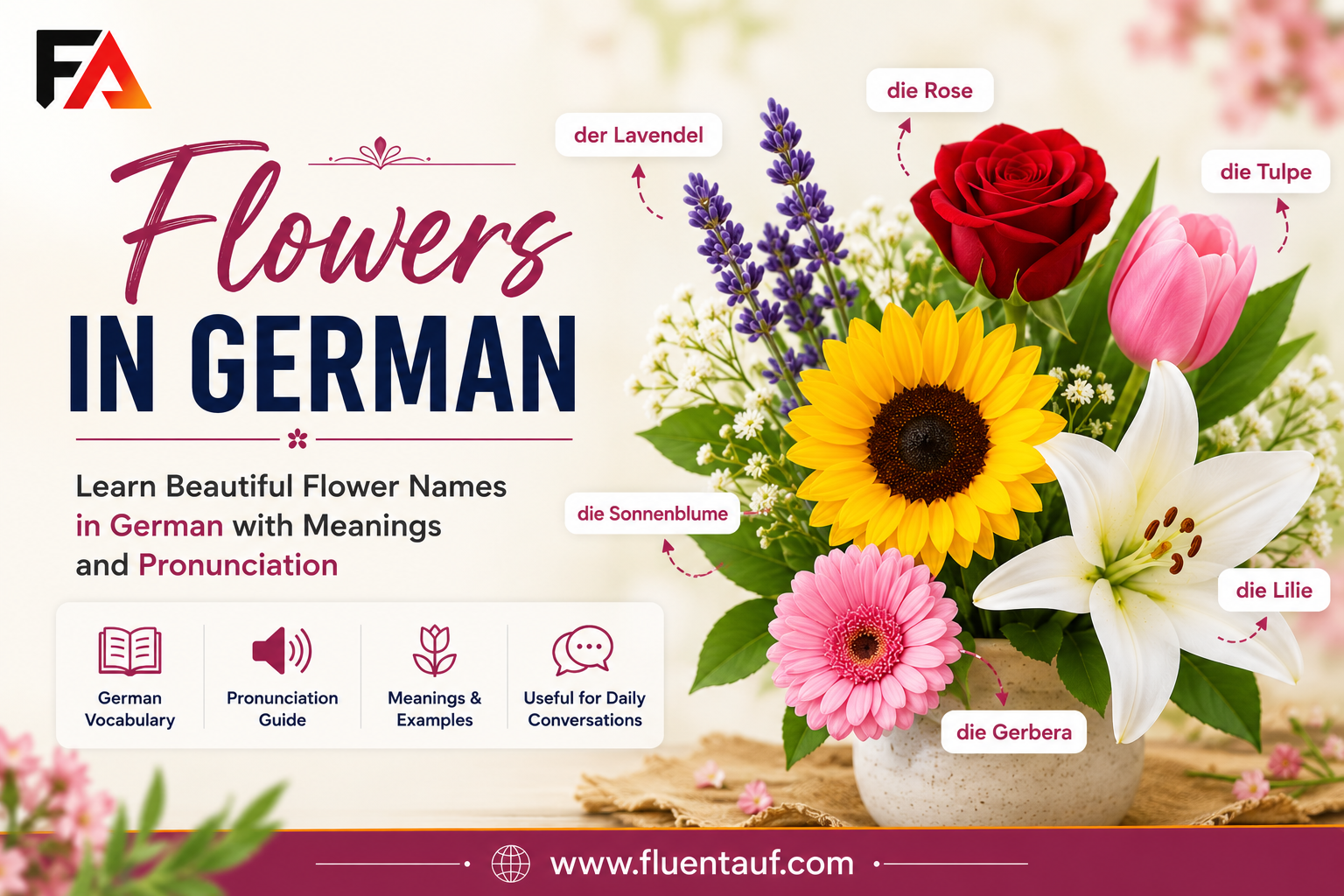
The knowledge of flower names in German will allow you to enrich your vocabulary and get acquainted with nature at the same time. It may be helpful both for beginners in learning this language and those who are going to pass German language exams.
In this article, you will learn German flower names, their English meanings, how to pronounce them correctly, and examples of usage.
Why Learn Flowers in German?
Learning of the flower names isn't only valuable for those who are fond of gardening; it is a good exercise for improvement of everyday vocabulary too. Studying of flowers in German language will allow you to talk about gardens, gifts, holidays, and seasons.
In case if you are a beginner in studying of German language, this theme will be great for expansion of your German A1 vocabulary.
Common Flowers in German
| English | German | Pronunciation |
|---|---|---|
| Rose | die Rose | dee ROH-ze |
| Sunflower | die Sonnenblume | ZON-nen-bloo-me |
| Tulip | die Tulpe | TOOL-pe |
| Lily | die Lilie | LEE-lee-eh |
| Daisy | das Gänseblümchen | GEN-ze-bloom-khen |
| Orchid | die Orchidee | or-ki-DAY |
| Lavender | der Lavendel | LAH-ven-del |
| Jasmine | der Jasmin | yas-MEEN |
| Lotus | die Lotusblume | LO-tus-bloo-me |
| Marigold | die Ringelblume | RING-el-bloo-me |
| Hibiscus | der Hibiskus | hee-BIS-koos |
| Carnation | die Nelke | NEL-ke |
| Peony | die Pfingstrose | PFINGST-roh-ze |
| Daffodil | die Narzisse | nar-TSIS-se |
| Iris | die Schwertlilie | SHVAIRT-lee-lee-eh |
| Poppy | der Mohn | MOHN |
| Violet | das Veilchen | FILE-khen |
| Chrysanthemum | die Chrysantheme | krü-ZAN-te-me |
| Magnolia | die Magnolie | mag-no-LEE-eh |
| Camellia | die Kamelie | ka-MAY-lee-eh |
More German Flower Names
Here are some additional flowers to help expand your vocabulary:
- die Begonie – Begonia
- die Geranie – Geranium
- die Hyazinthe – Hyacinth
- die Hortensie – Hydrangea
- die Glockenblume – Bellflower
- die Aster – Aster
- die Primel – Primrose
- die Anemone – Anemone
- die Freesie – Freesia
- die Krokus – Crocus
- die Schneeglöckchen – Snowdrop
- die Butterblume – Buttercup
- die Kornblume – Cornflower
- der Flieder – Lilac
- die Petunie – Petunia
- die Calla – Calla Lily
- die Dahlie – Dahlia
- die Mohnblume – Poppy Flower
- die Alpenrose – Alpine Rose
- die Edelweiß – Edelweiss
Read More- How to Say Vegetables in German
Flower in German Pronunciation
One of the easiest ways to remember new words is by practicing how they sound. Learning flowers in German with pronunciation helps improve both your speaking and listening skills.
| German | Pronunciation | English |
|---|---|---|
| die Rose | ROH-ze | Rose |
| die Tulpe | TOOL-pe | Tulip |
| die Sonnenblume | ZON-nen-bloo-me | Sunflower |
| die Lilie | LEE-lee-eh | Lily |
| die Orchidee | or-ki-DAY | Orchid |
| der Jasmin | yas-MEEN | Jasmine |
| der Lavendel | LAH-ven-del | Lavender |
| die Narzisse | nar-TSIS-se | Daffodil |
German Vocabulary Related to Flowers
Expanding your German vocabulary flowers list with related words will help you create complete sentences.
| English | German |
|---|---|
| Flower | die Blume |
| Flowers | die Blumen |
| Bouquet | der Blumenstrauß |
| Garden | der Garten |
| Plant | die Pflanze |
| Leaf | das Blatt |
| Stem | der Stängel |
| Petal | das Blütenblatt |
| Root | die Wurzel |
| Seed | der Samen |
| Bloom | die Blüte |
| Nature | die Natur |
Sentence Examples
1. The rose is red.
Die Rose ist rot.
2. I am buying flowers for my mother.
Ich kaufe meiner Mutter Blumen.
3. The sunflowers are beautiful.
Die Sonnenblumen sind wunderschön.
4. Many tulips grow in the garden.
Im Garten wachsen viele Tulpen.
5. She loves lavender because of its fragrance.
Sie liebt Lavendel wegen seines Duftes.
Colors of Flowers in German
| English | German |
|---|---|
| Red Flower | Rote Blume |
| White Flower | Weiße Blume |
| Yellow Flower | Gelbe Blume |
| Blue Flower | Blaue Blume |
| Pink Flower | Rosa Blume |
| Purple Flower | Lila Blume |
| Orange Flower | Orange Blume |
Read More- Colors Names in German
Steps to Learn German Names of Flowers More Quickly
- Learn five flower names each day.
- Learn to pronounce them.
- Flashcards with pictures will help.
- Watch videos about nature in German.
- Name flowers in your garden in German.
- Keep revising the vocabulary.
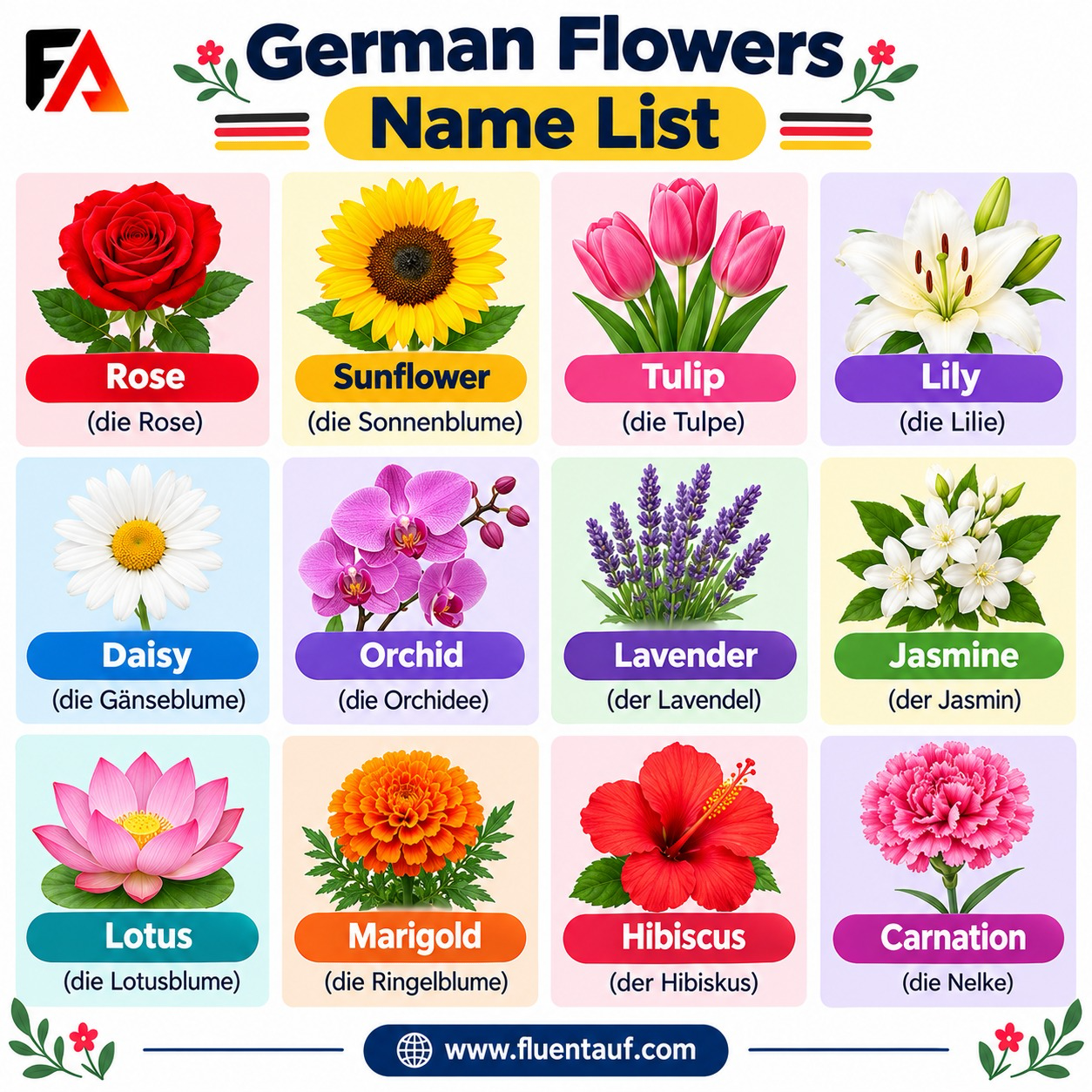
German Flowers Name list with Pictures
Practicing Exercise
Translate the following into German:
- Rose
- Sunflower
- Lily
- Daisy
- Tulip
- Answers
- die Rose
- die Sonnenblume
- die Lilie
- das Gänseblümchen
- die Tulpe
Conclusion
Learning flower names in German is an enjoyable way to expand your vocabulary while becoming more confident in everyday conversations. Whether you're interested in gardening, traveling, or simply improving your language skills, knowing these German flower names will make your German sound more natural.
If you're looking to learn German from beginner to advanced levels, FluentAuf offers expert-led online German courses, interactive lessons, and comprehensive vocabulary practice to help you achieve fluency. Start learning today and take your German to the next level.
FAQ's
How to say flower in german?
Flower in German language is called Blume. It is a basic word, usually learned by German learners at an early stage.
How do you say rose in German language?
In case you are interested in finding out how do you say rose in German language, the right translation is Rose. This word is pronounced ROH-ze and is among the most popular names of flowers in German language.
How do you say sunflower in German language?
Sunflower in German language is Sonnenblume. The name is formed from two words: Sonne (sun) and Blume (flower).
How do you say tulip in German language?
Tulip in German language is Tulpe. This word is very common vocabulary that often appears in basic German language courses.
How do you say lily in German language?
Lily in German language is Lilie.